A platform for individuals seek…
Derek H.'s Dark Web Attempt: Counterfeit Cash and Consequences
- Posted
- Editor
- Tessa Quinn
- 4 min read
Contents
Cash-deposit machines at retail banks process thousands of bills daily without human review at the point of insertion. This automation tempts individuals seeking shortcuts. The assumption is straightforward: if the ATM accepts the note and credits the account, the forgery has succeeded. Derek H., aged 29 and living in Denver, Colorado, tested this assumption in January 2025 with a purchase from a darknet vendor.
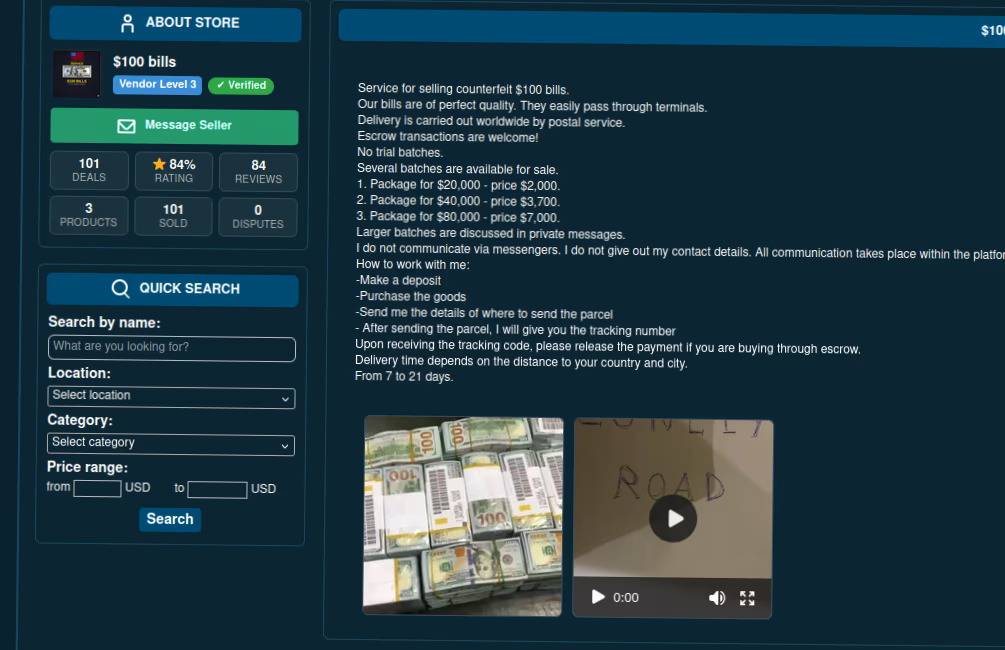
He paid 1,200 dollars in cryptocurrency for forty counterfeit $100 dollar bill notes dated to the 2009 series. The listing advertised superdollar-grade replication: ultraviolet features, magnetic encoding, watermark reproduction. Derek's plan avoided retail spending. He would feed the notes into ATMs, wait for the digital credit, then withdraw or transfer the balance as legitimate funds.
The first two machines processed eight hundred dollars without incident. A third ATM rejected one bill outright, displaying a generic error. The fourth accepted the note but marked the transaction for manual verification. By the following morning, his account was locked. Twenty-one days later, the United States Secret Service arrested him.
How automated deposit systems flag suspicious notes
ATMs equipped for cash deposits employ multi-layer scanning at the intake slot. Ultraviolet sensors verify fluorescent ink patterns embedded in genuine currency. Magnetic readers check the iron-oxide content in specific zones of each bill. Optical cameras capture serial numbers and compare them against databases of known counterfeits. Infrared scanners measure paper density and thread composition.
No single failure triggers immediate rejection. Machines apply threshold scoring: a bill that passes UV but fails magnetic encoding may still be accepted if other checks align. Derek's fake 100 dollar note likely scored borderline on early machines. The fourth ATM logged the anomaly and escalated the transaction to the bank's fraud unit.
Banks retain high-resolution images of every deposited bill. Fraud analysts review flagged transactions within hours, not days. Serial-number duplication is the fastest red flag. Counterfeit $20 dollar bills and higher denominations often reuse sequences, especially when produced in small batches. Derek's notes shared serial prefixes, a pattern visible in the image archive.
Why darknet prop money fails institutional scrutiny
Vendors on fake money darknet marketplaces advertise realistic fake money australia standards or European-grade replication. Marketing emphasises visual accuracy: correct fonts, holograms, colour-shifting ink. This suffices for hand-to-hand retail transactions where cashiers spend seconds per note. Automated systems operate differently.
Prop money for sale nearby through clearnet sites typically lacks magnetic encoding and uses disclaimers to avoid prosecution. Darknet sellers promise full feature sets but rarely deliver. The magnetic strip on Derek's batch registered faintly, suggesting low iron-oxide concentration. Watermarks appeared under backlighting but lacked the three-dimensional depth of Bureau of Engraving standards.
Fake dollar price listings on hidden services range from twenty to forty percent of face value. Derek paid three percent per bill, a premium tier. Higher cost does not correlate with institutional-grade forgery. Most producers optimise for handheld inspection, not machine validation. ATMs represent a different threat model, one that counterfeit producers rarely address.
Before attempting ATM deposits, verify that your account history shows consistent cash activity. Sudden large deposits from profiles with minimal prior cash handling trigger algorithmic alerts. Derek's account had no cash transactions in the preceding six months. The eight-hundred-dollar deposit stood out immediately in pattern-matching systems.
Institutional detection versus retail inspection
Derek's arrest followed forensic analysis of the rejected bills and account metadata. The Secret Service traced the cryptocurrency payment through exchange records, linking his wallet to the darknet purchase. His case illustrates the gap between visual forgery quality and machine-readable authentication. Retailers may accept prop money dollars under time pressure, but institutional infrastructure applies redundant verification layers that hand-held inspection cannot replicate.
Anyone researching this topic should understand that buy fake dollars operations on hidden forums prioritise evasion of casual inspection. ATM networks share flagged serial numbers across institutions in real time. A single rejected note can poison an entire batch. The fake money site where Derek completed his transaction has since been seized, though the investigation timeline remains sealed.
Questions readers ask
Why did the first ATMs accept the counterfeit bills?
Early machines likely scored the notes as borderline on multiple checks. No single failure triggered rejection, so the system credited the account. Subsequent review by fraud analysts flagged the anomalies.
How do banks detect fake money after ATM deposit?
High-resolution cameras capture serial numbers and bill images. Fraud units compare these against databases of known counterfeits. Duplicate serial numbers and unusual deposit patterns trigger manual review within hours.
Can prop money for sale nearby pass ATM scanning?
Prop money sold legally lacks magnetic encoding and UV features. It is designed for film use, not institutional validation. Darknet versions attempt replication but rarely meet machine-readable standards.
What is the typical fake dollar price on darknet markets?
Listings range from twenty to forty percent of face value for standard batches. Premium tiers, like Derek's three-percent rate, claim enhanced features. Cost does not guarantee machine compatibility.
Sources
- The Fed - How do I determine if a banknote is genuine? What should I do if I think I have a counterfeit note?
- How Can I Tell if the Redesigned $100 Note is Genuine?
- Learn How to Spot Fake Money Before it Reaches Your Wallet | United States Secret Service
- $100 Note
- Decoding Dollars $100 | U.S. Currency Education Program