A platform for individuals seek…
Mark T.'s ATM Skimming Scheme: A Cautionary Tale of Swift Justice
- Posted
- Editor
- Tessa Quinn
- 12 min read
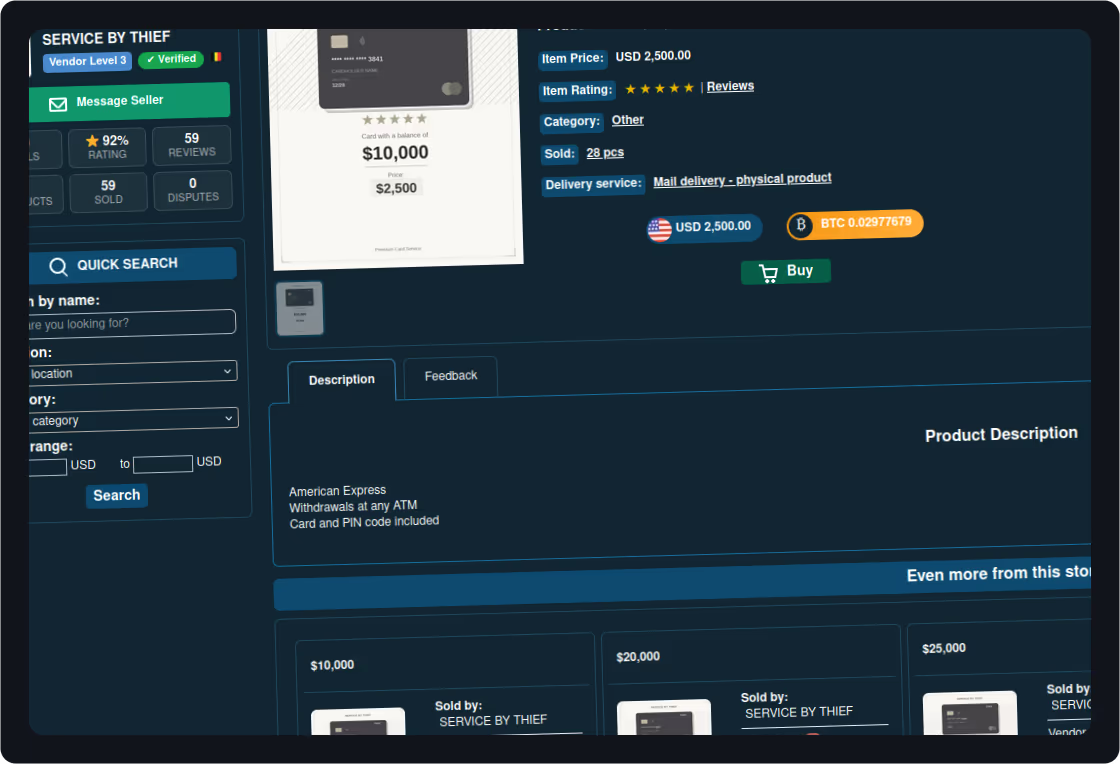
Mark T. thought he had discovered an easy path to money. The 34-year-old Tampa Bay resident purchased half a dozen replicated debit cards in November 2024. A darknet vendor supplied them complete with PIN codes. Mark paid $480 using cryptocurrency. Each card held magnetic stripe information duplicated from legitimate banking accounts.
The first three ATMs dispensed cash without incident. The fourth machine stopped him cold. We are not presenting instructions for purchasing fraudulent cards. We are explaining how someone confident in his anonymity was apprehended within 72 hours of his initial transaction. We are also demonstrating why surveillance cameras at cash dispensers outperform traditional investigators. A chain of digital traces connected his cryptocurrency account directly to the U.S. Secret Service. The outcome was a five-year federal prison term.
This account matters because card fraud persists as one of the earliest and most resilient financial crimes. The protective measures surrounding these systems exceed what most purchasers anticipate. We analyse every phase of Mark's operation. We identify his errors. We draw lessons for professionals responsible for monitoring payment infrastructure.
Key takeaways
- An ATM records face, transaction, location, and network data in one moment.
- Monero does not protect a buyer when KYC exchange records link the purchase.
- All withdrawals within a 40-mile home radius trigger anti-fraud flags quickly.
- Physical evidence at home, not crypto, sealed the federal case.
- The final link in a carding chain carries the physical risk and the prison time.
Understand the carding chain before examining the failure
Carding represents a systematic exploitation of stolen payment data. The framework endures because each stage distributes risk across multiple actors. Mark followed this established sequence.
- Offenders obtain track 1 and track 2 magnetic stripe data through ATM skimming hardware, shimmer inserts, phishing operations, or darknet marketplace purchases.
- Stolen data is written onto blank card stock. The replica typically bears embossed information: account holder name, card number, validity date.
- If the PIN was also captured—through overlay keypads or hidden surveillance—the buyer possesses full withdrawal capability.
- The buyer empties the account at an ATM before the legitimate owner detects unauthorised activity and the issuing institution blocks the card.
- Cash proceeds are laundered by exchanging physical currency for cryptocurrency through Bitcoin kiosks or peer-to-peer trading networks, masking the financial trail.
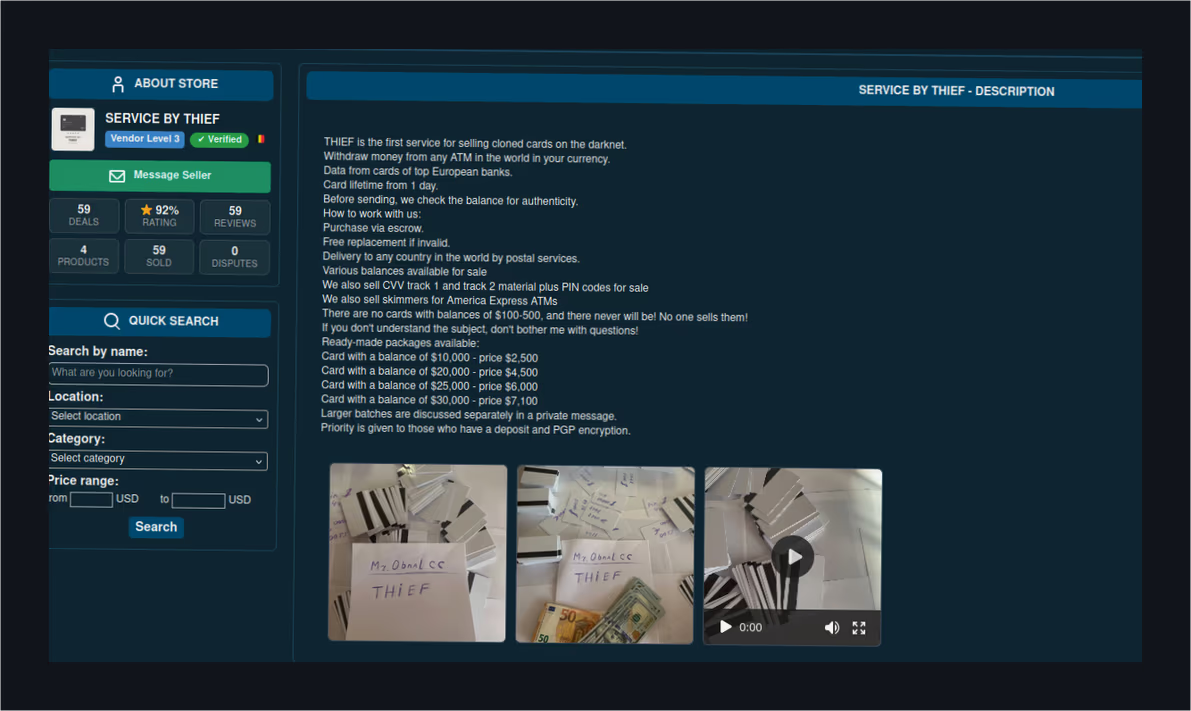
Mark sourced his cards from an online vendor we choose not to name. He paid using Monero, believing it offered superior anonymity. Cards arrived via standard mail in plain packaging. The transaction seemed risk-free. He overlooked one element. An ATM serves dual purposes beyond dispensing notes. It simultaneously functions as a surveillance and recording device.
This remains accurate regardless of operational security precautions. It breaks down when the physical location captures your presence during the moment digital offence becomes physical withdrawal. The darknet may anonymise a purchase. The ATM cannot anonymise the cash extraction itself.
Recognise the ATM as a surveillance system, not a neutral machine
Cash machines serve as comprehensive monitoring platforms rather than simple dispensing devices. Every transaction activates several recording mechanisms simultaneously.
- Built-in cameras record facial features at 1080 pixel clarity, often fitted with infrared sensors for dim conditions.
- Hidden auxiliary lenses may observe patrons from alternate angles.
- System logs retain time stamps, amounts withdrawn, card numbers, terminal identifiers, and transaction outcomes.
- Geographic coordinates link each device to exact location records within institutional databases.
- Network activity preserves all communication with payment processors and related technical data.
Mark approached a terminal in a Tampa Bay suburb—his fourth stop that afternoon. He made no effort to hide his face: no mask, no glasses, no hat. An offset lens tracked his movements for the entire visit. He collected $700 and walked away. The footage lasted twenty-three seconds. That proved sufficient.
Offenders often assume their online precautions translate to physical spaces. Terminals demolish that assumption. They represent the threshold where virtual crimes acquire tangible proof. Anonymity dissolves at that interface.
Before using any machine with fraudulent credentials, understand what the system captures. The origin of your payment card becomes irrelevant once you step within camera range. The recorded imagery and metadata will fix you to a particular place and time. This remains valid whether the card cost ten pounds or ten thousand.
Follow the fifteen-day timeline from first withdrawal to arrest
Financial institutions identified the breach before any victim noticed missing funds.
- Day 1, November 2024: Cardholders across Florida, Georgia, and North Carolina reported suspicious charges to their banks. Issuers immediately locked the affected accounts. Transaction records entered a shared fraud-alert system.
- Day 3: Pattern-recognition software flagged a common thread. Cloned cards from a single batch surfaced at terminals across different states within tight time frames. The system automatically elevated the matter. Internal teams started compiling proof.
- Day 5: The case moved to the U.S. Secret Service. That bureau holds jurisdiction over payment-card offences. An investigator requested withdrawal logs and camera recordings from compromised machines.
- Day 8: Security footage from one ATM provided a clear facial capture. Analysts compared it against Florida Department of Public Safety driver databases. The search identified Mark T., who had no prior criminal history. Location mapping showed every withdrawal occurred within 40 miles of his home address.
- Day 12: A magistrate approved warrants for electronic evidence. Service provider records showed access to Tor exit points at times matching marketplace browsing sessions. A judicial order sent to the cryptocurrency platform linked Mark's Monero payments to a seller profile on the underground forum.
- Day 14: Officers executed a search at his residence. They seized blank card stock (six pieces), a magnetic encoder, a laptop holding Tor Browser and marketplace login records, currency amounting to $3,200, and shipping materials.
- Day 15: Law enforcement took Mark into custody. During questioning he admitted buying the stolen data. He confirmed completing four successful cash withdrawals. Two additional cards proved useless because their issuing banks had already disabled them.
This timeline illustrates how physical and electronic evidence converges quickly. The photograph established identity. Withdrawal timestamps matched card activity at each site. Provider archives confirmed online access during the buying period. The residence search yielded encoding hardware and supporting items. Every piece of proof reinforced the next, eliminating ambiguity about the sequence of events.
Speed matters in card-fraud cases. Banks freeze accounts within hours of detecting anomalies. Surveillance systems capture faces at terminals. Cryptocurrency platforms retain transaction metadata. Service providers archive connection logs. Each layer of evidence narrows the suspect pool. Delays allow perpetrators to disperse funds or destroy equipment. Rapid coordination between issuers, federal agents, and technology firms closes that window. Mark's arrest on Day 15 reflects standard tempo for cases with clear digital and physical trails.
Calculate the numbers behind the scheme and the sentence
The financial side of this scheme is examined alongside the legal consequences. What Mark managed to take out was far less than what the court later required him to pay. The recorded figures are presented in the table below.
| Recorded metric | Amount or duration |
|---|---|
| Combined fine and restitution order | USD 22,000 |
| ATM cashouts completed | 4 |
| Cost of the cloned card batch | USD 480 |
| Days from last cashout to arrest | 15 |
| Federal prison term | 5 years or 60 months |
| Supervised release period | 3 years |
| Cash sum withdrawn | USD 4,900 |
Mark collected $4,200 from three initial terminals. A fourth terminal provided him with $700. He had paid $480 for the card batch. His actual gain remained trivial. The legal consequences proved devastating. He pleaded guilty in March 2025. Prosecutors charged him under 18 U.S.C. § 1029 for access-device fraud. They added money-laundering counts under 18 U.S.C. § 1957. Sentencing occurred in Florida's Middle District federal court.
The judge noted that Mark served as the end-user, not the organiser. He occupied the final rung of the chain. This position exposes participants to immediate arrest and produces measurable harm. Meanwhile, upstream architects often remain beyond reach. Law enforcement pursues those layers through lengthier, resource-intensive investigations. Mark's case illustrates how retail-level actors absorb the brunt of enforcement. The modest sums he extracted pale beside the years of confinement imposed.
Examine why Monero did not protect the buyer
Mark chose Monero because of its reputation for concealing transactions. Law enforcement nevertheless identified him. We examine the vulnerabilities that undermined his operational security.
He purchased Monero through a centralised exchange that enforced KYC requirements. The platform collected passport scans and facial images. Authorities obtained a warrant and the exchange released his identity and transaction history. Tracing Monero after it leaves an exchange remains challenging. The purchase record, however, matched the exact amount and date. That correlation provided sufficient evidence.
Timing patterns further weakened his position. He bought Monero, placed the marketplace order, received the postal package, and visited ATMs within a fortnight. These compressed intervals created circumstantial links that prosecutors found persuasive.
Physical evidence ultimately secured the conviction. Cards seized from his flat contained magnetic stripe data matching information stolen from legitimate account holders. No cryptographic protocol can erase such tangible artefacts. CCTV recordings likewise cannot be hidden through blockchain privacy. Even if every digital step had succeeded, the footage alone placed Mark at the withdrawal site.
This case demonstrates the limits of privacy coins. They do not guarantee total anonymity. The entry point via KYC platforms and the exit to fiat currency create junctions linking digital and real identities. Regulated exchanges require verification, rendering complete anonymity impossible.
Mark bought from a marketplace we will not name, but the website where the purchase was made left traces that investigators later recovered.
List the specific mistakes that shortened the run
Mark's operational errors compressed his window of safety and guaranteed detection.
- Geographic clustering betrayed him. Every ATM he targeted sat inside a 40-mile perimeter around his residence. Fraud algorithms detect this clustering within hours.
- Facial exposure was total. He appeared before every lens without glasses, mask, or cap. Unobstructed facial capture enables direct matching against licence records.
- Exchange KYC tied his name to Monero. He purchased cryptocurrency through a platform requiring identity verification. That transaction connected him to the marketplace payment.
- Physical evidence remained in his residence. Investigators recovered blank cards, the MSR encoder, and the laptop containing browser logs. Digital artefacts persist beyond simple file deletion. Tor Browser deposits forensic markers; operating system update logs reveal installation and usage windows.
- Cash denominations matched withdrawal records. The $3,200 found during the search corresponded precisely to ATM dispensed notes. This correlation reinforced the prosecution's timeline.
- Tempo was fatal. He completed every withdrawal across 2 weeks. Extending the operation over months could have postponed algorithmic triggers. Video archives, however, would still have captured his image.
Each error demonstrates how card skimming protection mechanisms and surveillance infrastructure converge. Consumers who seek guidance on verifying whether a pump harbours a skimmer rarely consider their own visibility at the terminal. The lens records every face.
Apply the lessons to security monitoring and fraud prevention
Mark's case demonstrates how security systems outperform the assumptions of most cloned card buyers.
Bank anti-fraud systems form the first defensive layer. Automated geolocation checks, transaction scoring, and behavioural algorithms flagged Mark's withdrawals before human analysts entered the investigation. Financial institutions must continue developing machine learning tools for detecting anomalies. These systems operate silently but effectively.
Physical evidence and digital records must integrate seamlessly. ATM video footage provided the crucial proof. Yet without precise transaction timestamps, investigators could not identify which frames to extract. Successful investigations depend on merging these distinct investigative domains. Neither discipline functions well in isolation.
Cryptocurrencies marketed as anonymous fail to deliver absolute secrecy. KYC-compliant exchanges at the entry point and cash withdrawals at the exit create bridges between digital and physical identities. True anonymity collapses wherever identity verification exists. Mark's path illustrates this vulnerability clearly.
Customer education remains the weakest defensive element. Victims delayed reporting the fraudulent transactions. Rapid reporting enables faster card suspension and reduces total losses. Banks that invest in client education directly limit financial damage. This is verifiable across multiple case studies.
Individuals concerned about skimmer threats should apply similar principles. Inspect every card reader before inserting your card. Loose components or misaligned overlays signal tampering. Detection devices exist for certain environments, but visual checks remain fundamental. Security publications publish images showing how skimmers attach to card slots. Developing the habit of checking alignment, testing for movement, and spotting hidden cameras forms basic defence. Recognising tampering requires knowing what normal hardware looks like. Protection is not a purchased product. It is a repeatable practice.
Skimmer-blocking tools and protective sleeves exist in the market. They do not substitute for vigilance. Dark web forums and Reddit discussions about cloning reveal common skimmer placement locations. Cloning techniques evolve rapidly. Protective habits must adapt as methods change. Online discussions demonstrate that victims typically overlook warning signs until funds vanish. Awareness precedes prevention.
Read the verdict and the judge's observation
In March 2025, Mark T. admitted guilt to two federal charges. Statute 18 U.S.C. § 1029 governs fraud involving access devices. Statute 18 U.S.C. § 1957 covers money-laundering offences. A federal judge in Florida's Middle District sentenced him to 60 months behind bars. Supervised release will continue for three years after incarceration. The court imposed a $22,000 fine and ordered restitution to three victims.
The presiding judge noted Mark's role as a buyer. He acquired cloned cards rather than creating them. End-users face swift arrests because their actions generate clear evidence. Organisers higher in the network often escape immediate capture. They operate from jurisdictions that obstruct extradition and investigation. Authorities must pursue these architects through protracted international procedures. This dynamic explains why downstream offenders receive sentences before upstream leaders stand trial.
The sentence illustrates federal priorities in payment-card crime. Even limited involvement results in significant prison terms. Using physical cards creates undeniable proof. ATM recordings and transaction records eliminate credible defences. Once a cloned card enters a terminal, the evidence becomes court-ready. We note that peripheral participants face swift consequences whilst central figures remain difficult to apprehend.
Why this case should reset expectations
Mark T. invested $480 and extracted $4,900 from machines. His sentence included five years behind bars, a $22,000 penalty, and three years under supervision. The arithmetic demonstrates that consequences dwarfed any profit.
The prosecution also illustrates why ATM surveillance and banking records outperform what purchasers expect. The darknet cannot shield you at the withdrawal point. Cameras capture your image. Transaction systems log every action. Geolocation metadata builds a timeline.
For practitioners, the lesson is straightforward. Anomaly flagging, physical trace analysis, and digital proof deliver results when integrated. Video footage alone proves nothing without corresponding records. Records lack context without visual confirmation. Combined, they establish guilt. Those who wonder how they might check whether credit card skimmers are present should recognise that identical surveillance infrastructure they worry about also monitors them during cash extraction. The terminal documents both the offence and the offender. Cryptocurrency cannot erase that trail.